
kodesh

What is a holy thing?
What is a beautiful thing?
Are the two, holiness, and beauty, related?
And is it right to place the two: holiness and beauty—in relation?
I often want to write about beautiful things, and holy things, often at the same time. I do think the two are in some sort of relation for me in some particular unconscious way, though I’m prone to equivocate out loud when I speak about the issue. The relation between holiness and beauty strikes me as possibly arbitrary and possibly erroneous, but with some education I might see their difference and let them set off on their separate ways. For now, however I am drawn to thinking of how spiritual light, and physical delight might be in some sort of relationship. I am aware that the holy is something set off in relief, a thing separate from the material or random happenings of “real life.” I am aware that the beautiful is similarly separate from the actual or the contingent; a thing of beauty is a joy for ever. And yet I seem stuck on the idea that the beauty misleads, whereas the holy draws us towards something truer than perception. That it is truer than aisthesis, the sensory mode on which aesthetic experience rests. It’s the first night of chanukkah and I wonder about the Greeks and the Jews and the conflict that has gone on since, as in the essay “Jerusalem and Athens” by Leo Strauss: “The peculiarity of the Greeks, according to Nietzsche, is the full dedication of the individual to the contest for excellence, distinction, supremacy. The peculiarity of the Hebrews is the utmost honoring of father and mother.” Later on: “According to the Bible, the beginning of wisdom is fear of the Lord; according to the Greek philosophers, the beginning of wisdom is wonder.”
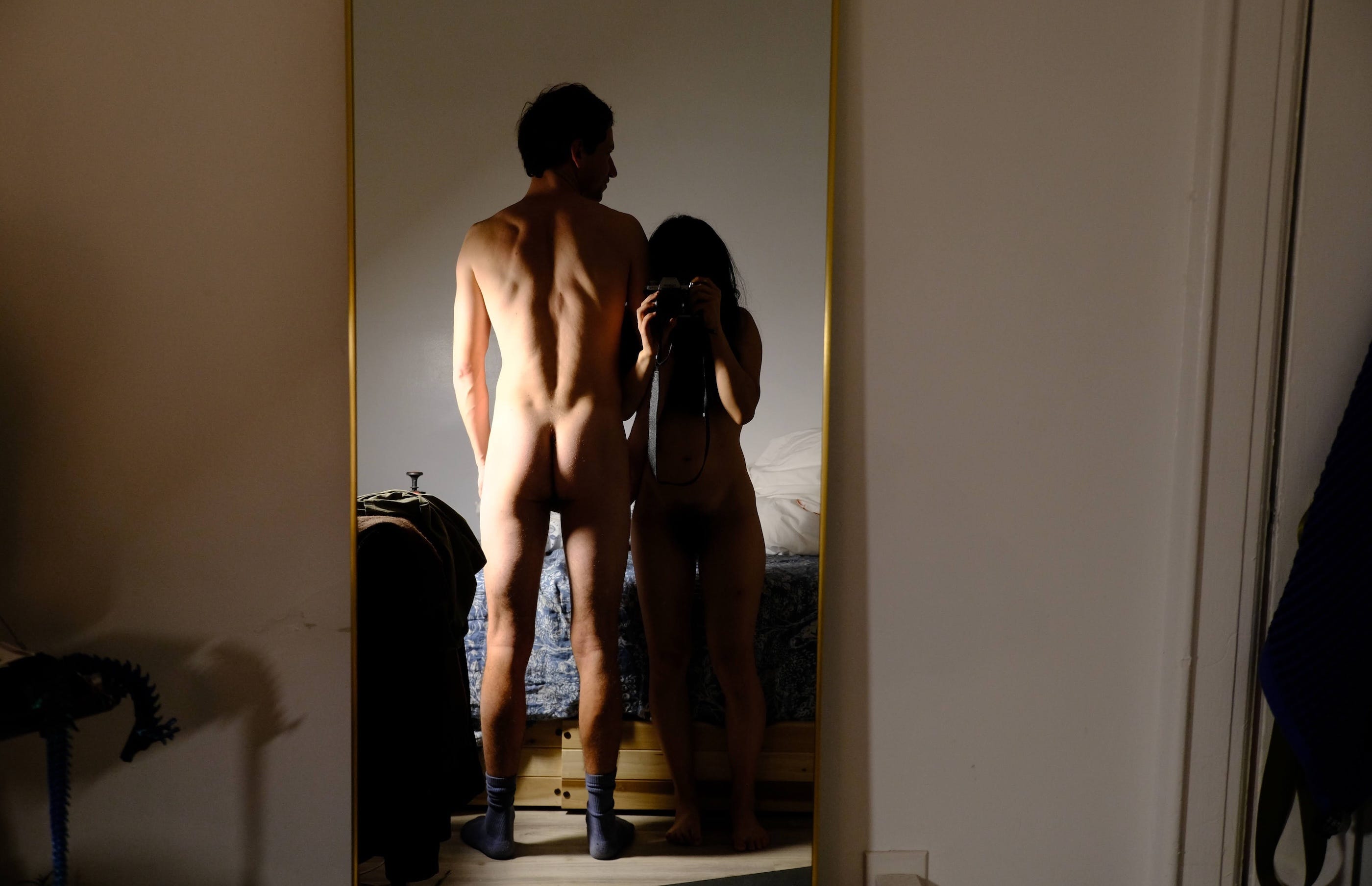
Wonderful is the speech of my patients, wonderful is the backside of a beautiful man, the sternum of a beautiful woman, but the thought of making any of this too perfect in an inert object, the form of writing, or of the plastic arts, or even of music, makes me fear the psyche of my mother. I lay in bed with Jerry for hours on Sunday and we fell asleep in one another’s arms. As we were in bed I said I loved his back, and I stroked his back, and his shoulders, and his ass. I said I wanted to write about his back and about how beautiful it was, that it was my task to write about his body and my body’s enjoyment of it. Later I wrote about how the lower back is the narrowest and boniest portion of the back, close to the curve of the buttocks, where the famous dimples are. I stroke and squeeze the hard parts and the soft parts surrounding them. I love the spine, the bumps of the thoracic vertebrae. In the lumbar region the male back feels so distinguished from the female back, because the hips don’t widen out again, so there really is this sense of finitude in the shape of the male back, a tragic, beautiful finitude, like that of the nose of an airplane headed towards an attack, a disaster, the idea of a male soldier consigned to give his life to the state. I felt it was weird or incongruent that I had arrived at this image of a military machine, but I left it alone.
All of a sudden I think of the word coup d’état. Then I enfolded him deeper into my life, I suppose this movement was mutual, as he met some of my psychoanalysis buddies, and I met some of his soccer buddies. I went to shul and met him afterwards, We spent time together which felt like holy shit, how did we get this intimate. I wanted to be alone after that and I fantasied about flirting with my neighbor. I told Jerry that the happiness was not specific to him, but rather to my having gone to synagogue for the first time, and we had a cruel exchange, a fight which dampened our spirits and made us sleep, in a way I felt was necessary and appropriate at the time and even retrospectively, having enjoyed the payoff of our new although the thought crosses my mind that had I been more in touch with something like a feeling, a feeling divorced from though, I would be able to avoid some of this neurotic conflict between what is true and what is apparent.
Much of the conflict which enables me to enact a certain violence against another comes from my refusal to think of the holy and the beautiful in the same sentence.
It has always felt safer for me to be an intellectual rather than an artist. I am afraid for some reason to be admired or to have my work admired. This is not something to be explained causally—there is no “because she is this, I am that.” Perhaps the closest I can get to seeing this fact from another angle, a true angle, is in the lines of that second prayer in the weekday shacharit which Leo Strauss cites in “Jerusalem and Athens.” רֵאשִׁית חָכְמָה יִרְאַת יְהֹוָה - re’shit chokhmah irat adonai - the beginning of wisdom is fear of adonai. Can this in some minimal sense refer to the mother, not the actual person of your mother and her thoughts, but something like the child’s inbuilt idea of the mother, or the unchanging unconscious notion of the mother as stored and created over some amount of time called a life, something truly quite metaphysical in the sense that it isn’t merely built over time as the result of various sensory inputs.
To make this more tangible I would propose that I remain there with my real mother’s unfulfillment. I cannot see a world in which I complete her by creating the art that she would have liked to have made, or which she would have liked to have seen someone close to her make, I am not on this earth to fulfill or complete my mother because I understand that it is in the lacking of it that she can feel desire.
I am not here to apologize for or account for an action, but rather to say, there is some connection here. I recently heard a shiur about the idea that there is a kind of correspondence, a non-causal, instantaneous correspondence, between what we do here on earth and what G-d experiences of us doing what we do, as in the basic idea that when one does a mitzvah G-d experiences a pleasure in seeing our pleasure in having done something with him in mind; the rabbi said this was like compersion. That is the kind of correspondence I want to engage in when I try to think. To me it is not right to attempt to convince someone of something they do not think, and it is the duty of thought to hold together that which is already together, but in order that we can witness that togetherness of the things which are already together.
So in this sense there is some connection between me going to synagogue and having a non-Jewish boyfriend whom I fight with sometimes because of who he is and who he reminds me of wanting to be, but of refusing to be: something to do with this warring thing in me between the holy and the beautiful, something in this inability to write anything for a public audience on the regular and this feeling that it would not be right to satisfy my mother’s desire by becoming something more like my creative and beautiful father, who was always a wanderer, and unlike her, so untethered to his homeland, so uninterested in returning to the homeland from which he came.
—
Psychoanalysis
O Goddess! hear these tuneless numbers, wrung
By sweet enforcement and remembrance dear,
And pardon that thy secrets should be sung
Even into thine own soft-conched ear…
(Keats, “Ode to Psyche”)
It isn’t holy, but it’s close: I think of psychoanalysis as the ultimate barrier between my parents and I: they would never do it. It is the last thing they would do, rather. It would threaten to end their hermetic ways, their arrogant ways of being alone, of isolating themselves from the possibility of envy or competition. It would force them to grapple with their investments in living a semi-fulfilled life which preserves the wound of having lost something to live in a country which they find so strange, a country they only lived in in order to marry. My mother claims she would have returned to Taiwan if it weren’t for my father, who didn’t want to go live in Taiwan with her, so much is invested in this marriage, in this enemy of a country, and what her offspring might represent. It would be anathema for my mother in particular to create a strong tie to anyone other than her offspring. To become enmeshed with some stranger, a psychoanalyst, would be to get married again, in a way that ensured an even more prolonged separation from her homeland. It might even force her to consider finding a new husband. And psychoanalysis, let’s admit, isn’t beautiful, but it can get close, it can be beautiful. It is in this sort of beauty that some danger lies.
Psychoanalysis is still, often, and perhaps should always be associated with the darkness of a bygone nineteenth century way of thinking. Psychoanalysis forms the basis for my interest in Judaism. I recall Harold Bloom’s essay on Freud, in Take Arms Against a Sea of Troubles, in which he posits “Jewish dualism is neither the split between body and soul, nor the abyss between subject and object. Rather it is the ceaseless agon within the self not only against all outward injustice but also against what might be called the injustice of outwardness or, more simply, the way things are.”
Hellenism on the contrary is central to the history of Western Art, and light is associated with truth and knowledge in the Western philosophical tradition. Light is a precondition for visuality. Perhaps this is why I find Keats so wonderful. Everyone seems to be sleeping, dreaming, or lost in reverie in his poems. But he is dealing with the notion that truth or beauty correspond in a certain way that remains separate from the sensory, mortal world, and the idea that we see, or cannot see this:
O brightest! though too late for antique vows,
Too, too late for the fond believing lyre,
When holy were the haunted forest boughs,
Holy the air, the water, and the fire;
Yet even in these days so far retir’d
From happy pieties, thy lucent fans,
Fluttering among the faint Olympians,
I see, and sing, by my own eyes inspir’d.
(Keats, “Ode to Psyche”)
In the midst of these two traditions lies the actual lives of psychoanalysts and their patients. I sometimes wonder, in amazement, at the speech of my patients, and I sometimes dream beautiful dreams of encountering them outside the consultation room. Such dreams are so full of force and terror, a kind of terror that begins with beauty. The terror lies in the ostensible crossing of boundaries which occurs when a patient and analyst interact outside of the proper frame of a session. The terror comes from the fact that the patient has penetrated the analyst’s mind by appearing when her mind is in its most passive, or most uncontrolled state. But what about the beauty?
A dream is not a private movie. It is an experience of one’s own thought. A dream is powerful and strong, its beauty lies in this muscularity or flexuous tension, in its ability to think under such constraints. A dream must allow us to continue sleeping, and thus it cannot disturb us too much. But it must be wrought with tension, in order that we remember it and find a way to represent it as a story with beginning, middle, end. The beauty in these dreams comes less from the sensation of experiencing some external object in the world, but from the awe one feels when waking from the dream.
I wake in awe, I wonder at how the dream thinks incompatible thoughts, how it substitutes one thing for another, how it is able to bundle what I cannot bundle, and then to sequence its scenes or images just so that there’s enough tension within the story for me to remember it later, for me to wish to marvel over it later. I have had dreams in which patients have kissed me, dreams in which I meet the patient’s father, dreams of meeting my analyst in public, dreams in which I have sex with my analyst, dreams in which my analyst asks to watch me have sex with my first analyst. These are sensational scenes, full of transgression, but what stands out is not what happened but how beautifully well the dream composed its constituent elements.
But I find that the basic script of the dream is banal when set down in words. The dream’s aesthetic comes from something nonverbal, something like the appreciation of the patient’s irreducible characteristics, physical and bodily qualities which I’ve often been unable to articulate in case presentations and technique classes and supervision. It’s the dream in which I see the remains of the patient’s body after the session ends, after speech has been deactivated, after their independent existence.
This is a slippage, a displacement, from the original pairing of the holy and the beautiful. Now I ask about the experience of the patient’s body in the dream, and how this strange unfamiliar sight relates to the analytic process or activity of knowing.
There was a special quality to our initial sessions. Namely, I couldn’t feel what it was that was troubling him so that he would come to therapy. He claimed he wanted to figure out how to work on his art practice, and on how to find feedback on his art. But I couldn’t feel the contours of the suffering that might have led him to come, just the speculative yearning or abstract searching that came along with this topic. And so he was apparently untethered to a symptom, like a plane soaring high above himself. Yet he came back again and again, and I knew some desire drove him to come back.
—
Should I, Should We?
One of the earliest sessions involved a discussion of the valences of the word “should.” The patient was speaking about how someone had questioned his use of the word “should.” “I feel like I should make art […]” he had said. Why did she question my use of the word “should? There was something that had bothered in her in his use of the word “should,” and this in turn bothered him. He felt the “should” had nothing to do with social pressures; it was a “should” emanating from within. This “should,” he said, felt akin to the laws of nature, which made me in turn think of natural law, or law of a universal nature derived through reason, the opposite of Jewish law or halakha, which often doesn’t make sense, but which derives its force and weight from a combination of tradition and one’s love of G-d. It excited me, as I sat there listening, to think that the imperative to make might not simply be tied to the notion of self-expression. In this session the patient provoked me to wonder about how one might perfect oneself, independently of all others, through the creative act. What is the relationship between creation and the should of the law? What is the artist’s law? What is the writer’s law?
I selfishly wonder if the idea of the should, or an imperative to create within certain frameworks or according to certain laws, pertains in any way, for my patient, to the idea that Jewish law negates or sidelines certain forms of artistic work: those which deal with the visual representation of human forms. It is the second of the ten commandments: “Thou shalt not make unto thee a graven image, nor any manner of likeness, of any thing that is in heaven above, or that is in the earth beneath, or that is in the water under the earth; thou shalt not bow down unto them, nor serve them; for I the Lord thy G-d am a jealous G-d […]” I wasn’t even aware of this proscription of images, or “Jewish aniconism” until a few months ago, but when I became aware of it, it became an obsession of mine. Arguably everything I think revolves around it.
Now I face guilt around attempting to represent in words aspects of a patient of mine. I tell myself that what I am writing is largely about me, and that the sparse anecdotes I employ in representing the patient are really being used in the service of some sort of educational material, some sort of philosophical investigation. I presume that if the patient were to find what I’ve written, it would not be particularly damaging, insofar as it is clear that the vignettes are fragmentary and do not attempt to reconstruct anything larger than themselves. This is a whole other order of encountering the law.
The dream of the patient revolved around him seeing something which I have wanted him to see, but which I suppose he shall never see or speak about. He came into the room and stood at the head of the couch. The room was the consulting room of my analyst, and the couch was the couch I lie on four times a week.
Instead of sitting, he stood and looked down at me.
As he looked down at me I noticed him staring at the back of my phone case. I knew what he was looking at, and felt compelled to admit that the sticker on the back of my phone case, a worn-down matte silver hexagon, was from the Jewish Museum. He looked at me with an expression of revulsion and incredulity, which I can’t exactly remember. It may have become a harder, stonier, magnified expression of true and immediate angst. All his knotted thoughts were turning into something like hatred.
I knew from this hateful gaze that he had realized that I was both a Jew, a wannabe Jew, a Jew-fetishist, and an orthodox woman dressed in vaguely provocative long skirts all the time. My favorite line from the dream: “You’ve ruined orthodoxy for me.”
You will notice that this wasn’t a sex dream. It was duel-like, confrontational. It could very well have been a sex dream and I woke up from the dream feeling thrilled. The patient once told me that his favorite film is Barry Lyndon, which I had watched soon afterwards. Ever since, I have sometimes wondered if he is in need of a worthy enemy. Will he ever find a worthy enemy in me? And if so, does he want to win? Does he want to lose? What would it be like if I were to destroy him in some way, or to see him at the edge of death or some form of total abasement? At the end of the dream his face looked like that of a man who had just been violated or humiliated in some military setting. The idea of me as not only Jewish, but as a frum woman in long skirts was the final blow. Perhaps there was some disgusting sexual charge to the long skirts I often wore in the summer. And while the feeling of having damaged our therapeutic relationship filled me with remorse and imminent sadness, I seemed to delight in having pricked this patient who seems so impossible to perturb.
The dream came to me during the Thanksgiving break, when there had been a longer interval of days between sessions. When the patient came back he spoke very little of Jewishness, and began to speak instead of his mother and his family’s sexuality. I became ever more attuned to how attractive I found him, and how a comment his mother had made about his body mirrored my own response to that part months earlier. I became attuned to how his own forms of promiscuity mirrored mine. The patient said something that made me feel as if I had received an interpretation from him: having sex with someone for the first time allows me to peek at the other, at how the other has sex. and i quite enjoy this. You spoke earlier of your love of windows, I said. It occurs to me that the window had been a precondition for peeking. But in this situation, of sex, the window is no longer necessary. What do you make of that?
He agreed with my remark, and wondered at the fact of it. One does not need a window to peek at the other in the case of sex. Privately I wondered if he had also picked up on the slip of mine, in which I had referred to “this situation,” as opposed to “the situation of sex.” I seemed to want to say that we were in the situation of sex.
We were guys wrestling around for the first time, we were both watching with fascination how the other does it, and marveling at how we react to how the other does it. All this happens through words. But in a dueling fashion we plant ourselves across from one another, mutually challenged by the fact that we are aware of one another’s gaze, and by the fact that we are not sure who will make the first move.
But after the session ends, I leave the building shortly after him and see him walking down the street. Instead of averting my eyes I watch. I can catch glimpses of his hat or jacket or bag amidst the crowd; he is otherwise hardly recognizable to me, with his back turned, moving among so many others who block so much of the view. What is he thinking in these moments directly after the session? How does he feel? And does anyone see him walking through the street see him and think of how beautiful he is?
Investigation ain’t over. Stay tuned for the next essay in this series…
👁️