
tonka
objects of guilt and attraction

Part A
His cheeks are smooth like apples; his hair curls like a setter’s ears, in a shade of dark reddish blond, the red of it recessive and obscure. His eyes are an obscure organic shade of lichen. His ass is curved like a helmet. I love the mute details of his backside. I love the backs of his arms, the lines in the sides of his shoulders, all of which evoke traditional ideals, the shapes of corinthian columns, the shapes of Hellenic statues of muscular males with none of the paint left on the white marble. When he moves, he moves with the grace of a gecko. He rests the way a gecko rests, its tail curved and curling, sometimes quivering and vibrating with terror or excitement at the vision of a mate. Then it suddenly launches itself onto another surface, as he does when he begins to speak, muttering in a low strange voice. Then I feel like I’m in a haystack at night, illuminated only with a candle which drips all over the iron stick. Then he hesitates before producing the strangest sentences, often as-if scenarios, or jokes of some kind. What constitutes a joke? A stroke of genius? His jokes betray total freedom of mind, and he sinks from this into a silent blankness which makes me want to cradle him in a manger next to a bleating lamb in the middle of the dessert. I’d shower him with tokens if he was a content creator, I’d pay for every video he released. Does he know that I think of these specific metaphors, or that the whole point of sex to me is to come up with these figures in my mind? I guess he knows that if he’s within my reach I can’t help but kiss his face all over. When I kiss him I seek out the softest and most delicate skin beneath or above the eyes. I feel that he is an animal accepting incomprehensible gestures from another animal many clades away. Perhaps I suck at his surfaces like a fruit fly. Or I am a man kissing an otter, a man kissing a carrot, a man kissing an orange springtail, a man kissing a mourning gecko, an isopod kissing dead skin cells. I feel my skill and capability at adoration when I encounter him but then it’s absorbed into whatever we do on the bed. Once I asked him for permission to come over to his house to kiss his fingers, and when I came I first kissed and hugged him by the threshold of the door, as if we were on TV, before kissing his fingers and toes like a troubador attempting to gain favor from a haughty princess. He claims there’s no good in writing about someone you love, but I claim that I feel proud to crystallize my desire and make it a permanent thing. Not in order to do away with it and hide it, but in order to intensify it, to see it brightly, and to link the intense attraction of a mourning gecko’s gold-flecked eyes as captured by my camera to the more diffuse warmth of holding him close to me and kissing him again and again and again. I am aware that I have invented this and other thoughts. My lover, my son, my lover-son. So robust and handsome and shaped like a hero. I can smell you in the air, even though I am focused on the technicalities of writing something robust; nonetheless I brush my nose against your neck, thinking of the unbitten softness, then I forget, and then I remember.
Part B
One of the bad habits I’ve established in life involves going on dates with others when I’m already in a sort of relationship with someone else, a far more established one, which nonetheless remains noncommittal. I’ve been trying to break this habit, but I was on a date with a new man last weekend, and I told him about this paragraph I had written. This paragraph which is about another man I’ve been in a much more well-established but non-committal relationship with for several months. The new man was Jewish, and in fact from a Yeshivish/Litvish Orthodox upbringing in Lakewood, NJ. He is no longer observant, and is now very interested in Christianity, in large part for aesthetic reasons, as he claims that Judaism lacked a place for aesthetics, and that it lacks a place for tragedy, and that he admires the tragedy and beauty in the story of the Passion of Christ. We had a long back-and-forth about this on our first date, which turned into a second date, consisting of more theological debates.
We met at the MET the second time. He admitted that he felt “sucked in” by many of the paintings in a way that felt disturbing, and that it felt somehow sacrilegious to look at the many portraits, many of which were of Christ. Looking at the artworks reminded him of the utter derangement of the senses of a psychotic patient, or of how it felt for him to leave Yeshivish Lakewood. Everything turned upside down, absolutely no one affirmed what he believed for much of his life; he had been a skeptic from as early as he could remember. We were sitting on a bench as he said this, looking at a landscape, a sunset with lurid oranges behind a scrim of dark tree branches and trunks and shadows within the underbrush and I told him that I too found it uncomfortable to look at paintings for too long, particularly when they involved human subjects, while a landscape was a bit easier to see.
While walking around Central Park afterwards, I admitted that I had been very invested in trying to find my secular way into understanding avodah zarah, or the prohibition of idol worship and of the creation of graven images, through a creative exercise. I had set out to write a portrait of someone I knew, and I wanted to see how guilty it would make me feel. It made me feel so guilty, I said, that I deleted it. Well, I saved it, but deleted it from the document at hand. I didn’t tell him what the portrait involved or what it depicted, just that it was a friend, though in fact it was of a man I find adorable and beautiful and whom I’m currently seeing and sleeping with.
But I didn’t think of that too much, as I was excited to find myself astride a man from the Yeshivish community, who was trying to become more immersed in a world of Christian art and aesthetics. And how useful I felt, as a secular-born Asian woman who was trying to become Jewish and who was willing to talk about the little I knew of Kant’s notion of a universal morality based in universal aesthetic judgment, and Hermann Cohen’s reinterpretation of Kant to reframe Jewish religious morality! But as the hours went on I could tell that the man was feeling a bit distant and a bit tired of speaking about theology, as was I, so I asked him if he was attracted to me. He ended up rejecting me, for the following reason: I was too masculine for him. “It’s not like there’s no attraction,” he said, but I still felt hurt, finding with muddled surprise that this particular rejection felt so painful. To me he had revealed how much I had failed to rise up to my duty or metaphysical life’s task as a woman, which was to be beautiful and attractive and desirable and soothing to be around, not “smart.”
Later I realized that he might have seen me as “masculine” because of the way I had engaged in intellectual debate with him. I imagined that in his community, the one he had gone through so much to separate himself from, girls simply didn’t talk the way we did. Perhaps I came off too much like a classmate in yeshiva, and maybe, given his avowed “homophobia,” he had been a bit attracted to me in a way he didn’t like.
I went home and felt my tail tucked between my legs in shame for about a night. Meanwhile, the subject of the portrait, with the hair that curls like a setter’s ears, was on his way back from a vacation on a Caribbean island. He’s not Jewish at all. It was Rosh Hashanah and he kept on sending me videos and photos of lizards and geckos. When he got back from vacation I told him about my little exercise, and I asked him if he thinks of me as a woman, or as feminine. He told me that he didn’t, with a rapid little waggling tail-like “no,” but then said of course he thought of my shape as that of a woman. just look at you and your shape, you’re a woman. He added that he didn’t know what it meant to think of me as a woman otherwise; less emotional maybe compared to other girls and so easier to relate to. I grinned a lot, and while I was attentive to his words, the greater part of my attention marveled at his beautiful shape and at the notion that I had just been blessed to have a little time with this beautiful man.
Part C
He did introduce me to a wondrous piece of writing lately, a book of Robert Musil’s stories, which includes a story called “Tonka,” which I’ve just started reading recently. In many ways it is a portrait of a woman or of a relationship between a man and a woman, though it is unevenly focalized through the male narrator’s gaze. I wonder while reading this story if it’s true that any act of portraiture could be construed as idolatrous, because something of this story is so aniconic, but so sensuous regardless.
At a hedge. A bird was singing. And then the sun was somewhere down behind the bushes. The bird stopped singing. It was evening, and the peasant girls were coming across the fields, singing. What little things. Is it petty if such little things cling to a person? Like burrs? That was Tonka. Infinity sometimes flows in droplets.
Well, I certainly wouldn’t feel guilty if I wrote such a delightful opening. It doesn’t strike me as an instance of idol-worship at all. Unlike a “graven image” it isn’t graven, and it doesn’t inspire worship. It feels rather alive, a flowing stream of words within a larger thought. One wants to know what the story knows, or thinks, after this.
There’s a combative motif throughout the story. This is also delightful, and it troubles whatever wholeness one might associate with portraiture, or with images surtout:
It was summer. When evening came, the warmth of the air was exactly the same as that of one’s face and hands, and, walking for a moment with closed eyes, one felt as though one were dissolving, expanding, floating… He described this to Tonka, and when she laughed, asked her if she knew what he meant.
Oh yes!
But he was still not sure that she did and so he tried to get her to describe it to him in her own words. And this she could not do.
So then, he said, she didn’t know what he meant.
Oh, but she did! and suddenly she said: it made you want to sing.
For heaven’s sake!
But yes—that was it, she protested.
They went on wrangling like this for a while. And then after all they both began to sing, rather in the spirit of someone firmly placing the corpus delicti on the table or inspecting the scene of the crime. They sang pretty badly, and something from a musical comedy, at that, but fortunately Tonka sang softly, and he was glad of that little sign of consideration for his feelings.
[…]
Then Tonka suddenly broke off too, as if she felt the same thing, and for a while the two of them walked along in silence.
Then Tonka stopped and said: “That’s not what I meant at all, about singing.”
And since she saw in his eyes a little glint of responsive kindness, she began to sing again, still softly, but this time folk-songs from her own part of the country. So they walked along, with these simple tunes making everything vaguely sad, like the fluttering of cabbage-whites in the sunshine. And so now all at once it turned out, of course, that Tonka was right.
The arrogant narrator is so certain of his images. He doesn’t want them to be desecrated with the vulgarity of singing. Then he realizes that she knows something he doesn’t, and that through the song, or maybe the frame of combativeness around it which they have both contributed to, that the song contains some real image-like force, like that of the fluttering of cabbage-whites in the sunshine. And then after a while this questioning of images is tied together in the following delightful resolution:
He stroked her hand. “I think we get on well together, Tonka. But do you really understand me?”
After a while Tonka answered: “It doesn’t matter if I know what you mean, or not. I couldn’t say anything anyway. But I like you to be so serious.”
These were all very slight experiences, of course, but the remarkable thing was that they happened all over again, exactly the same. Actually they were always there. And, even more remarkably, later they meant the very opposite of what they had meant in the beginning. Tonka always remained so simply and transparently the same that it was almost like having a hallucination, seeing the most incredible things.
There is this theme of understanding. Does the upper class educated man understand the lower class woman and does she understand him? That theme itself supersedes whatever might be idolatrous in the appreciation of literary images, this actual urgent ethical question around the relationship and what it can and cannot do. I rather enjoy how Musil breaks into abstraction, taking progressive time out of the story in brief, resolute statements: “they happened all over again, exactly the same. actually they were always there.” Musil’s “portrait” of this woman named Tonka isn’t really a portrait; it is more accurately an act of portraiture, a story that is being told, and a story as it is being told involves a search for truth which I believe images never really converse in. On the other hand, images can capture something in such an immediate fashion, they can capture an image of a whole, and that is their force, and their gravity, and their awesomeness, and that is why they inspire worship. That is the reason for avodah zarah to be framed around images in particular, as they do have a dangerous tendency to inspire adoration, but I’m afraid that the same could be said about the man I have portrayed in words, the man whom I’ve shortchanged so often by choosing to write of instead of be with, the man whom I find so distracting on account of his round ass.
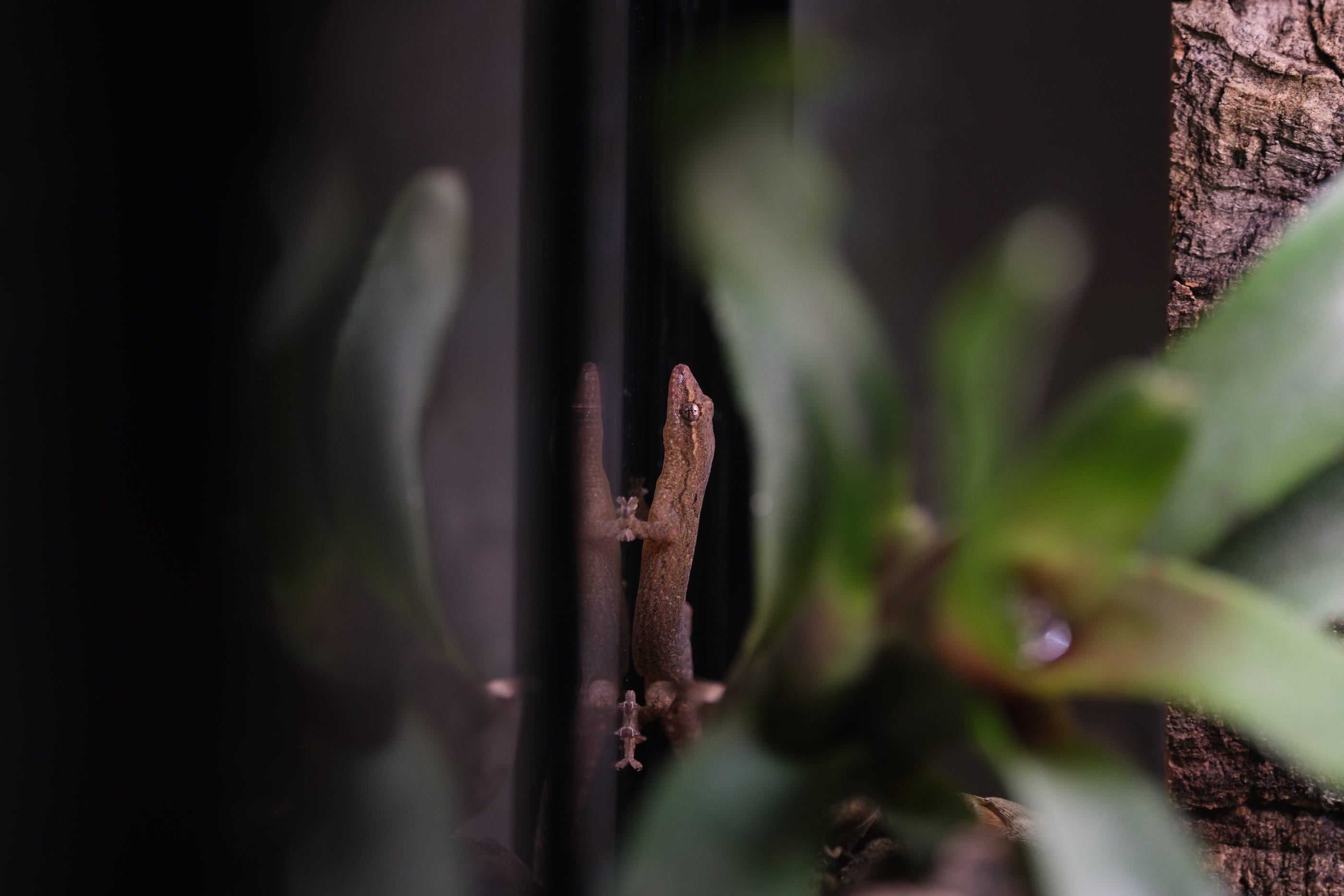
(Tribeca, the oldest of my three mourning geckos)